12 Cookbooks for you to check out

In January, I decided that I wanted to cook 12 recipes from 12 new-to-me cookbooks. I was rocking and rolling and then the world turned upside down. Somewhere in September (honestly, what to months mean anymore?) I remembered this desire and got to work.
Yesterday, I completed my 12th recipe with the Sweet Potato Honey Beer Pie from Nik Sharma’s The Flavor Equation.
Cookbooks in order (you can find the cookbooks and recipes I made on IG under my “Cookbooks” highlight.
Nadiya’s British Food Adventures: Over 120 Fresh, Easy and Enticing New Recipes x Nadiya Hussain
Jubilee x Toni Tipton-Martin (Instant classic. I LOVE how Tipton-Martin weaves history all throughout and let’s us know how integral Black chefs are to American cuisine. Love it.)
Dinner in French x Melissa Clark
The Full Plate x Ayesha Curry (Would highly recommend this for cooking chill, delicious food.)
Zaitoun x Yasmin Khan ( I LOVE this cookbook. I’ve already made 2 recipes from it and can’t wait to work my way through more of it. Shoutout to my best friend who bought me my own copy after seeing how much I loved the electronic book I checked out from my library.)
Parwana: Recipes and stories from an Afghan kitchen x Durkhanai Ayubi
Drinking French x David Lebovitz
East x Meera Sodha
Nopalito: A Mexican Kitchen x Gonzalo Guzmán and Stacy Adimando
Tartine All Day x Elisabeth Pruett
Mixtape Potluck x ?uestlove and Friends (I’ll definitely be buying this. I love ?uestlove’s interdisciplinary mindset and how he weaves all of his passions together. Also, shoutout to him for being an Aquarius.)
The Flavor Equation: The Science of Great Cooking Explained in More Than 100 Essential Recipes x Nik Sharma
10 Books I’d Recommend from my 2020
Looking for book recommendations? Check out my favorites from 2020.

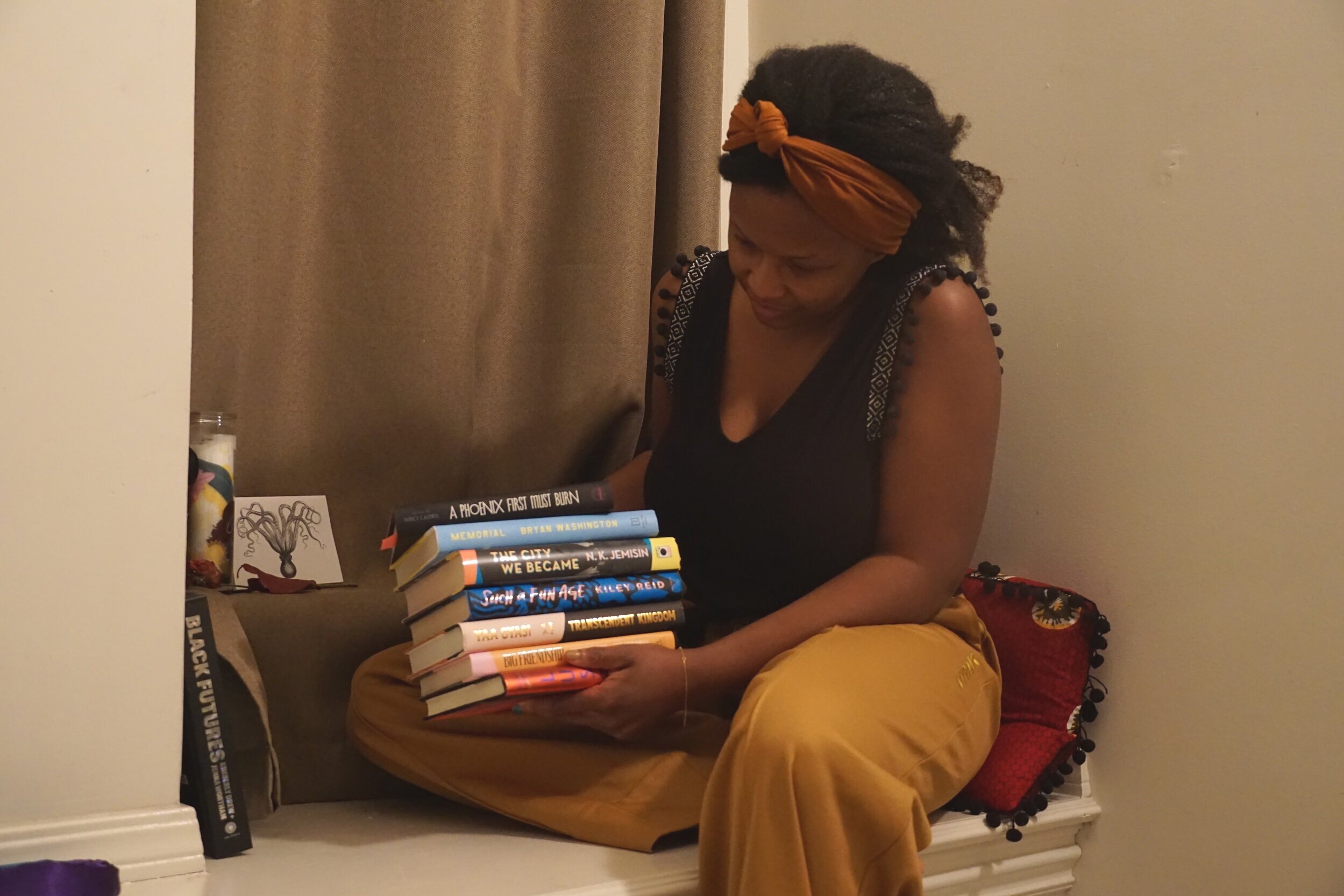
In my reading and writing nook.
2020 has been a year to say the least. For all that it was, it was also a year for me that was filled with good books and the beloved community (for me that means the bookclub I’m in with phenomenal women and all of the Bookstagram homies) they entail.
Without further ado, my top 10 of 2020, in no particular order.
Breasts and Eggs x Mieko Kawakami
The City We Became x N.K. Jemisin-I loved this book. I might mess around and re-read it because it was so riveting.
Want x Lynn Steger Strong
Memorial x Bryan Washington-This book was gifted from the publisher, but I would have bought and loved it had they not sent it. I love the essential Houston-ness of Washington’s work and how the stories could only originate from such a mish-mash of a city. If you love food and/or Houston (one of the country’s best culinary cities), I’d highly recommend reading this book and listening to Bryan on The Sporkful.
The Death of Vivek Oji x Akwaeke-This book was beautiful and heartbreaking. Truly stunning.
The Secret Lives of Church Ladies x Deesha Philyaw-This collection of short stories did what needed to be done. My favorite short story collection of the year.
Finna x Nate Marshall-I reconnected with poetry this year and I’m so blessed that “Finna” came into life at a time when I needed it. Just read it. If you’re Black, I’m sure you’ll find several poems that resonate with you.
Wayward Lives, Beautiful Experiments x Sadiya Hardman-I found this book to be so affirming. It’s an exploration of the ways that Black women and nonconforming folks created ways out of no way during (even more) oppressive times. It felt truly celebratory to honor their memories and defiance.
The Meaning of Mariah x Mariah Carey with Michaela Angela Davis- I wasn’t a Lamb before, but after experiencing Mariah’s audiobook memoir, I’m Lamb. I don’t make the rules.
Zaitoun x Yasmin Khan-This is a cookbook that has become my new favorite cookbook. At the beginning of 2020 I decided I wanted to cook 12 new recipes from 12 new-to-me cookbooks. I’ve made two recipes (Pomegranate Passion Cake and Freekeh and Butternut Squash with Spinach) from Zaitoun already and am already preparing a third. I originally checked it out as an ebook from the library, but one of my best friends gave it to me as a gift when she saw how much I loved it.

How I learned to stop hating and enjoy the Real Housewives (of Potomac)
In the Before Times, I was someone who didn’t watch Reality TV.

While I didn’t (outwardly) judge people who did, I had a lot of pride in being someone who didn’t really do reality tv and especially not the Real Housewives franchise.
But then 2020 happened and all bets were off.
I didn’t have a lot of goals for 2020 post-COVID-19’s emergence in the world, but I did decide I wanted to be (slightly) less judgmental. So I started by pickingr up (checked out ebooks from the library) a romance series from the library and realized that not only could I be a romance reader, but it was possible that I was missing out on other fun stuff by being a snob. Several months later and the Reluctant Royals series is EXTREMELY my ish.
What else had I been missing out on?
So I mentioned to a few close girlfriends that I wanted to try to get into a Real Housewives franchise. Turns out many of the most brilliant women in my life had been having fun and I had been missing out for no reason than my arbitrary thoughts about what “good” “worthwhile” entertainment was. Wack.
I selected Potomac because it felt like the barrier to entry was lower-5 seasons compared to 5011 like other franchises. I was quickly hooked by these larger than life women cutting up on my tablet screen. Turns out, disliking something isn’t a personality trait. In a year where joy was harder to come by, I’ve relished the shenanigans of these ladies and the ensuing recap conversations with my girlfriends. Additionally, 2020 has taken away a lot of the usual venues for gossip that many of us have had with offices closes, happy hours cancelled, and more, many of us are separated from the quotidian gossip and banter that makes life interesting.
So what I have gained from watching RHOP besides laughter at how outlandish these women are?
A study in plot and character development, hunny!
Because I assume that the conversations and carrying ons are heavily edited, I’m able to look at the show as fictionalized story. From a narrative point of view, despite changing alliances and plot lines, the ladies have their characters down pat without being mere caricatures.
The conceits of the show over the seasons are great reminders of how a change of setting can advance the plot along. For instance, if the drama is getting low, have someone suggest either a girls trip or a good old-fashioned girls night out and see what happens. If there are too many separate plot points or conversations happening, have one of the characters (it’s almost always Ashley, no?) not directly involved in the drama try to get to the bottom of the tea.

It’s been fascinating watching storylines from the earlier seasons re-emerge and I can’t wait for tonight’s season finale.


Book Review: “FORESHADOW: Stories to Celebrate the Magic of Reading and Writing YA”

October has been a month where I invested in myself as a writer.
I applied to the Rooted & Written conference and was accepted (more on that at a later time), but I planted the seed for this dedication in September when I said yes to an opportunity to participate in Algonquin’s Blog Tour for “FORESHADOW: Stories to Celebrate the Magic of Reading and Writing YA” edited x Nova Ren Suma and Emily X.R. Pan. I’m thankful I had the opportunity to read an advanced copy of this anthology because it came at the perfect time. #Shoutout to Algonquin Young Readers.
FORESHADOW is a collection of 13 short stories from diverse authors who I can’t wait to read more from. Stories like “Risk” brought me back to the awkwardness of high school and the sacredness of girlfriends, while “GLOW” reminded me of the intensity of first love. “Fools” was a treat from the heartless protagonist to the many many layers of nuance in the twisted fairy tale. All of them were engaging, and I especially enjoyed:
"Glow" by Joanna Truman,
"Risk" by Rachel Hylton
"Fools" by Gina Chen
"Belly" by Desiree S. Evans.
There’s truly something to suit everyone’s taste in this collection. In addition to the unique stories, there’s the added gift of the accompanying essays that focus on a specific writing technique and writing exercises. I found myself stopping after each story to reflect on what worked for me and what didn’t, and considering what I could incorporate into pieces I’m writing and then trying the writing exercises. I can’t wait to engage with the other work these authors create and I’m excited to implement the technique lessons.
This book would make a great gift, or investment rather, in a writer you care about whether that’s yourself or another loved one. It also makes for good reading and who doesn’t need more of that?
Buy it from your preferred independent bookstore, Bookshop, or here.

The Book Connect or Read These Books Together Pt. One

If you just read the synopses for these two books, Transcendent Kingdom and Godshot, they seem radically different.
Transcendent Kingdom features a young Black middle class woman who is trying to make peace with her family’s personal tragedy in the midst of a national opioid epidemic by pursuing scientific answers. On top of all this, she’s also learning new ways to exist with her grieving mother.
Godshot features a poor white little white girl being raised by a single mother in a religious sect who has to grow up too fast and figure out a way to question and then exist.
However, and perhaps it's because I read them relatively close together, I think they complement each other really nicely. Loosely inspired by the great Shea Serrano’s new podcast “The Connect”, I’m going to run down things these two books have in common:
They are both coming-of-age stories that feature a daughter-mother duo;
The mother in question is deeply involved with religion;
The previously mentioned devout daughter has a crisis of faith prompting her to reevaluate her relationship to religion;
The authors invite us to think about motherhood, agency, and community;
The books’ settings are in rural places; and
At some point the books also both take place in California.
If you’ve read these two books are there any other connections I’m missing?
On Women and Cannabis

I started reading this book wanting to learn specifically how cannabis usage could be beneficial for women and it does that in a really helpful way by defining terms one might have heard and breaking options down in a really helpful way. However, I also fully expected a book about cannabis in 2018 to acknowledge how racism has played and continues to play a part in who gets to participate in cannabis capitalism or even just enjoying recreationally. Despite that jazzy cover and title, I was not the target audience for this book. I live in a state that allows for recreational cannabis use (🙌🏾) and an area that is trying to figure out what racial equity in the cannabis industry looks like given decades of racist drug enforcement policies.
I read this book deeply feeling it wasn’t for me, despite my interest in the topic. It was clearly meant for middle-aged women and/or caregivers to breakdown the misconceptions around cannabis use and normalize it for a certain group of people, but from my POV that’s already happened. How much more impactful this book could have been if the author or publisher added historical context.
I read it as a Black woman who was taught that cannabis was the Devil’s weed and a gateway to a life of debauchery and sadness. Clearly that’s wrong (even though studies do show that using cannabis too early in life isn’t great for brain development). I now use it regularly in facial moisturizer and I have to chuckle at how normal it is in my life and social circle. I’m glad I’ve grown up to learn more and that individuals and organizations are working to educate about cannabis usage. It’s just imperative that those conversations include race. I hope there’s a book in the works by a Black and or Latinx woman in the works that centers how women of color can approach cannabis into their wellness journeys.
Recommended Reading
Why Isn’t Marijuana Legalization Doing Any Good for People of Color?
Organizations Working to Make the Cannabis Industry more Inclusive and Equitable
Millennial’s Lament

“We cannot live outside the systems and structures, but, it turns out, I cannot live within them either anymore”
-Want x Lynn Steger Strong
Our protagonist in Want struggles with economic anxiety.
Not the kind that makes people vote for a racist and deplorable person, but the variety that compels someone to declare bankruptcy, work two jobs, and seek escapes and solutions in unlikely places.
Our (mostly unnamed) protagonist has lost track of her adolescent best friend, lost her professional narrative and professional security and is wrestling with her place in so many systems: the charter school where she works, parenthood, marriage, and capitalism to name a few. In her story, I saw shadows of friends and peers who also did all the right things, got the multiple degrees, and yet life doesn’t look like what we were promised or sold.
Want explores the different types of lack that can affect us in this part of the 21st century, lack of community, lack of being understood, and especially lack of stability which means money. She deals with this lack by escaping into books or movies, or other indulgences she can’t really afford and by trying to reconnect with her old best friend.
So what happens to dreams deferred for an individual for a whole generation? A lot of it depends on your race, gender, class, and other dimensions of diversity. Our protagonist, whose name you learn near the very end of the books, lives outside of her privilege in a lot ways, but even the dire economic circumstances she finds herself in are mitigate by her Whiteness. Through flashbacks to her adolescence and current quotidian life Steger Strong shares a story that is at once intimate and also universal.
“We were just privileged enough to think that we could live outside the systems and the structures and survive it, but we failed.”
It was a fascinating experience reading this book in the summer of 2020 when so many people are reconsidering the systems they benefit from and those that consequently, intentionally hurt others.
A few things:
Read this novel along with Lynn Steger Strong’s "Two in Five" column with the Guardian that depicts the decline of the middle class.
This book would pair nicely with It Was All a Dream: A New Generation Confronts the Broken Promise to Black America. It’s an exploration of how Black millennial navigate the lie of the “American Dream”.
One thing that I haven’t been able to shake is that our protagonist allegedly was a year older than me, but the text said 9/11 happened her second week of college. It’s a minor mistake that I’m sure can happen to anyone, but this tragedy is a fundamental event anchoring millennials to their/my/our generation.

To Be Young, Confused, and Black

My twenties were the best of times and the worst of times.
Graduating into a recession and deferring decisions about what to be when I grew up (still there, to be honest) coupled with the multitude of decisions about who and how to be made it a difficult time. Add navigating relationships, situationships, and entanglements, and there were some rocky times. Reading Luster brought me back to the worst of times, yet I couldn’t put it down.
Our girl Edie is having a rough go of her twenties too.
From the first few pages (and from many other reviews) we know that Edie is messing around with a married older white man who claims to be in an open relationship (and actually is?!). Edie/Leilani’s observations about their differences and standing in the world hooked me through her frank, cutting, and at times hilarious prose. Throughout the novel, Edie explores her relationship with her older, married lover, muddling through her job until she finds herself unemployed and unhoused and suddenly invited into the house of her married lover AND HIS WIFE.
I was enthralled by Leilani’s prose, but when this plot twist dropped (which appears in most reviews and the book cover jacket) my mouth dropped, but then when the couple’s daughter is introduced I almost lost it. Leilani manages to weave observations about black colleague solidarity, artistic fulfillment, and so much more with prose that floats.
The poor decision making, the discontentment with her job, it all resonated too much.
Edie is lonely and confused. Her loneliness and confusion compounded by being a millennial in these weird times. I was Edie in varying measures throughout my twenties and Emira (Such a Fun Age x Kiley Reid), and even had to check to see if I saw myself in Queenie (Queenie x Candice Carty-Williams).Their narratives are important not only because they are well-written books, but because they are expanding the types of Black women who get to see themselves and their experiences on the page.
“I can be a beach read, I can get rid of all these clauses, please I’ll just revise.”
I’m here for Edie and Emira and all the other twentysomething Black girls trying to figure it out. Here’s to more of our stories.
I’m rooting for us.

What to do with all this time?
“I do feel comforted to discover I’m not the only person on this earth who has no idea what life is for, nor what is to be done with all this time aside from filling it.”

Photo of Intimations x Zadie Smith
I’m not sure where I fall on Zadie Smith the author or public figure.
I liked NW well enough but was ambivalent about On Beauty. I really didn’t enjoy Swing Time and have felt some kind of way about some of Zadie’s essays that have to do with the specificness of Black American life. All that being said, she’s still very much a writer I will read and even seek out. When I heard that she had written and published something during All of This, I knew I wanted to read it. I was fortunate that my public library system (the award-winning San Francisco Public Library system) had it and that I was able to check it out so quickly.
Intimations is a short collection of six essays that range from exploring those first uneasy weeks of the new normal to people she encounters navigating this new world we all find ourselves in. It’s an opportunity to listen in on a famed writer’s internal monologue and it was affirming to listen to many of my feelings and spiraling thoughts, reflected back to me, tidier, and more potent, in Zadie’s incomparable prose. One of her essays, “The American Exception”, was previously printed in The New Yorker and provides a good sampling of the other five essays in this collection. It’s both inspiring and frightening to read commentary on the still-unfolding global merde show. I’ve struggled with how to make meaning, if not sense from this [insert your favorite adjective to describe 2020] time.
The fact that Zadie was able to fight through a fog of complacency and despondency to put pen to paper makes me want to find a way to contribute, in my small way, to the archives of what inevitably will come from this time. It likely won’t be in the bagels I’ve sworn myself to perfect, or even in the little pieces of art, I’ve tried to make to make sense of the madness of 2020. Like Zadie, “I can’t rid myself of the need to do something, to make something, to feel that this new expanse of time hasn’t been wasted. Still, it’s nice to have companions watching this manic desire to make, or grow, or do something that now seems to be consuming everybody.”
I finished this quick audiobook emboldened to keep trying to create during this time, comforted to know that I’m not the only one struggling with what to do with all this time…
More
The Care and Keeping of Best Friends

“There is no autopilot mode for a Big Friendship. You just have to keep showing up. Active friendships require active maintenance.”
As someone who didn’t meet my husband until my late 20s, my friendships, particularly my female friendships were the big, important relationships in my life over the past nearly two decades. I’m grateful to have 5 best friends. You might be thinking that best friend is singular, but let Dr. Mindy Lahiri educate you:

The 5 women I consider my best friends live in 5 different cities throughout the United States and the one time all of 5 of them have been in the same place was at my wedding two years ago. At a time when I’m not sure when I’ll be able to see them all again in-person, I cherish that weekend all the more, but it can be hard to prioritize investing in these relationships and showing up outside of the big, monumental moments in our lives. I was excited to learn from these two Big Friend Pioneers. Like Gayle and Oprah, Anne and Leslie, Aminatou and Anne are vocal about their platonic love of each other and I love to see it. I’m not a frequent listener of their podcast, “Call Your Girlfriend”, but as someone who is online more than I should be, I was familiar with their work and legend.
This short, but potent, book is not really for those hoping to learn how to make friends as an adult (although you can pick up tips if you’re looking!) and instead focuses on sustaining a deep, valuable friendship. I appreciated how open the two were in sharing about the good, bad, and trying of their commitment to each other and how their narrative weaves qualitative and quantitative data to provide a guide to embracing and investing in Big Friendships. The chapters isolate and highlight certain aspects of their friendship as a way to clearly help them process their evolving shared narrative. The resulting book is a dedication to their practice of committing to a Big Friendship. I found myself highlighting, underlining and dog-earing sections I know I’'ll need to reference when friendship tune-ups are required. In 2020, their chapter on the unique challenges that can happen in interracial friendships is especially timely and value, you can read an excerpt here.
Before shelter-in-place began, I found myself feeling emotionally distant from one of my besties. Despite these feelings, I didn’t do anything about it. It was easy to downplay the feelings as temporary or just a phase, but they existed. As I was reading this book, I found myself tearing up, remembering why I connected with this best friend in the first place. When I was finished reading it, I ordered her a copy from my former favorite independent bookstore in her area. I’m grateful that this book provides a map on how to stay in the land of deeply loving your friends and I’m excited to force my best friends, I mean gift my best friends this book as a declaration that I want to keep doing life with them.
P.S. This is definitely a book I’d recommend to (fictional) Issa and Molly.